
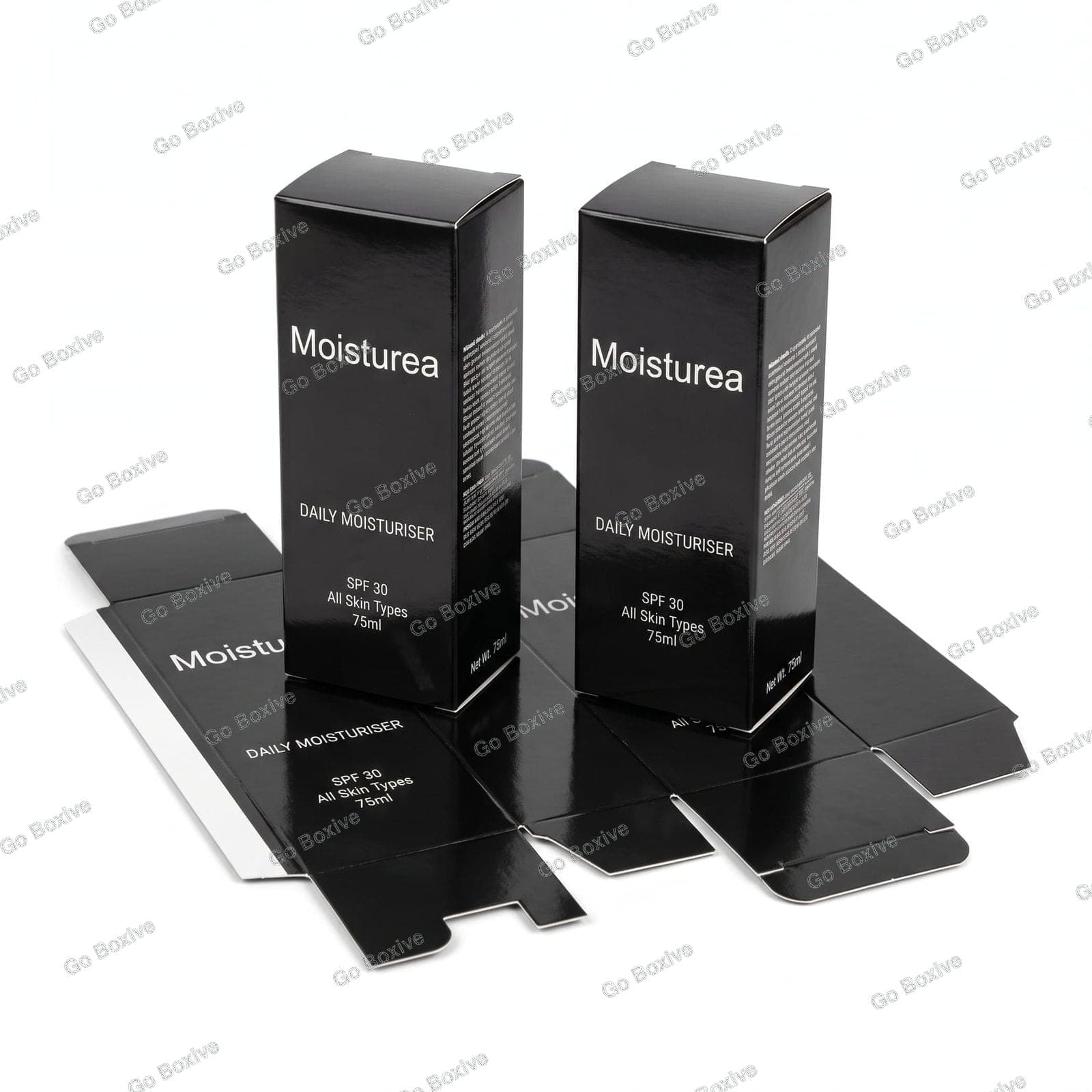
"How much does custom packaging cost?" is the first question almost every brand asks, and it's also the hardest one to answer with a single number — because unlike a box off a shelf, custom packaging isn't one product, it's a spec. Two boxes that look almost identical in a photo can be priced completely differently depending on quantity, material, construction, and finish. Instead of guessing at a number that won't apply to your order anyway, here's what actually moves the price, in the order it usually matters.
Quantity is the single biggest lever, and it's also where the industry norm quietly filters out small brands before they even get a quote. Most custom packaging suppliers set a minimum order of 1,000 to 5,000+ units, because that's the volume where their setup and plate costs stop mattering per-unit. There's no minimum order here — you can order as few as 100 units — which means the per-unit price at low volume is naturally higher than it would be at 5,000, but you're not forced to buy packaging you don't need yet just to unlock a price. As your order size grows, the per-unit cost comes down significantly, since the fixed costs of setting up your specific box spread across more units.
Material and stock weight are next. A lightweight cardstock mailer costs less to produce than a rigid two-piece box, not because rigid "looks nicer" but because it's genuinely a different construction — two separate components (lid and base) built and wrapped individually, versus one piece of stock cut and folded. Corrugated sits in between, priced by flute and board weight rather than a single number (see the paper stock weight guide for how that scale actually works). If you already know your product is heavy or fragile, that alone will tell you roughly which end of the range you're in before a specialist even prices it.
Box style and construction add or remove cost independent of material. A standard tuck-end auto-bottom is about as efficient to produce as packaging gets — no glue required at the point of use, minimal material. Add a magnetic closure, an interlocking auto-lock bottom, or a separate tray-and-sleeve construction, and you're paying for the extra material and assembly steps those features require. None of this is arbitrary upcharging — it's a reasonably direct reflection of how much more box you're actually getting.
Print and finish are the most controllable part of the price, because they're the most controllable part of the design. Full-color printing costs more than a two-color job; foil stamping, embossing, and lamination each add a step to production. The good part: exploring these options doesn't cost anything extra on its own — design support is free with unlimited revisions, so you can see a two-color version and a foil version mocked up before deciding which one is worth it for your budget, instead of guessing blind.
Because every one of these factors is specific to your actual product, there's no honest fixed price list to publish — a real quote is built from your exact spec: product, quantity, dimensions, and stock. If you'd rather skip the back-and-forth, describing what you need on the quote form gets you a real number, priced against your exact spec, usually within a day. And if you already have a quote from another printer, send it over on the Beat My Quote page — a specialist will price the same spec and see if it can be beaten before you commit.


